
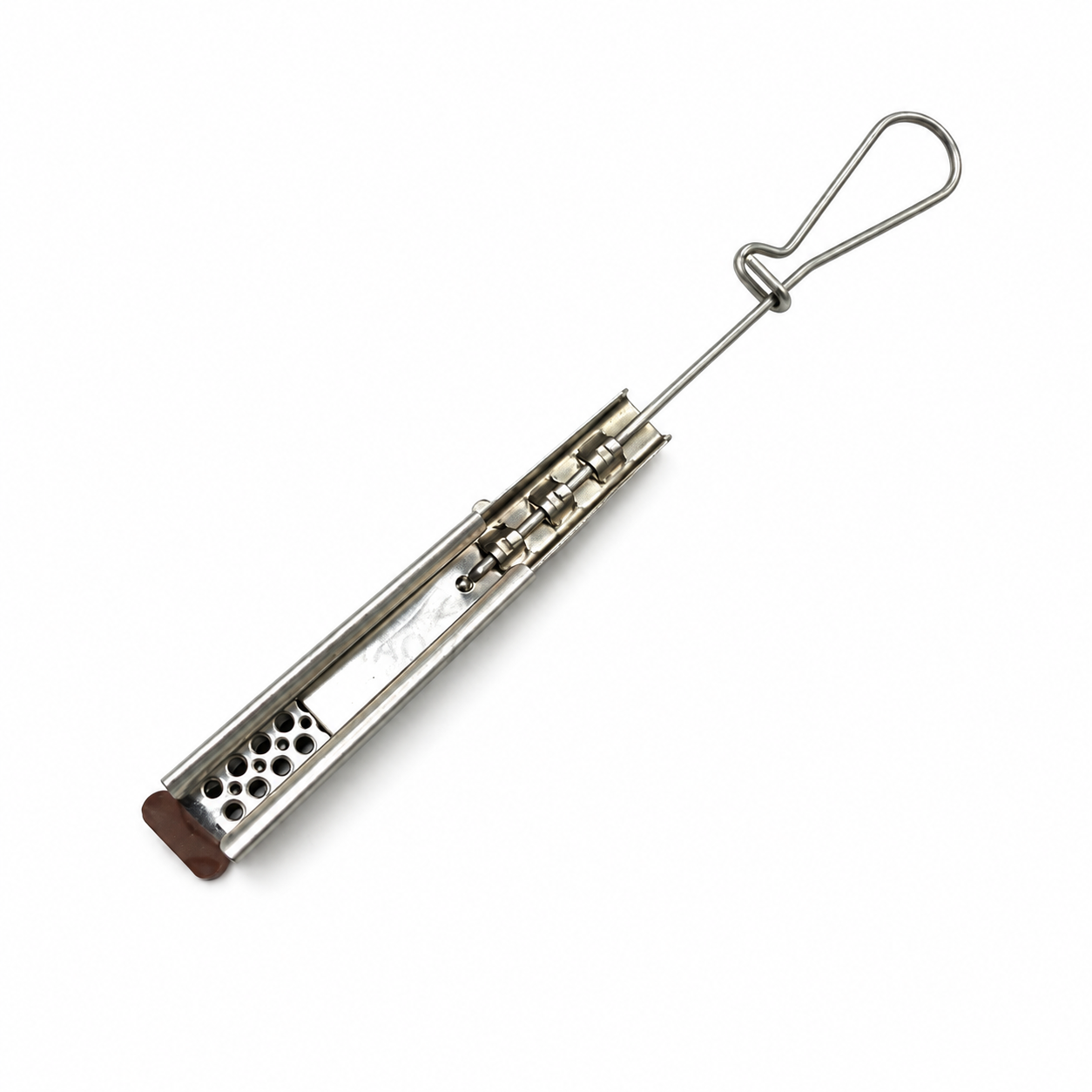
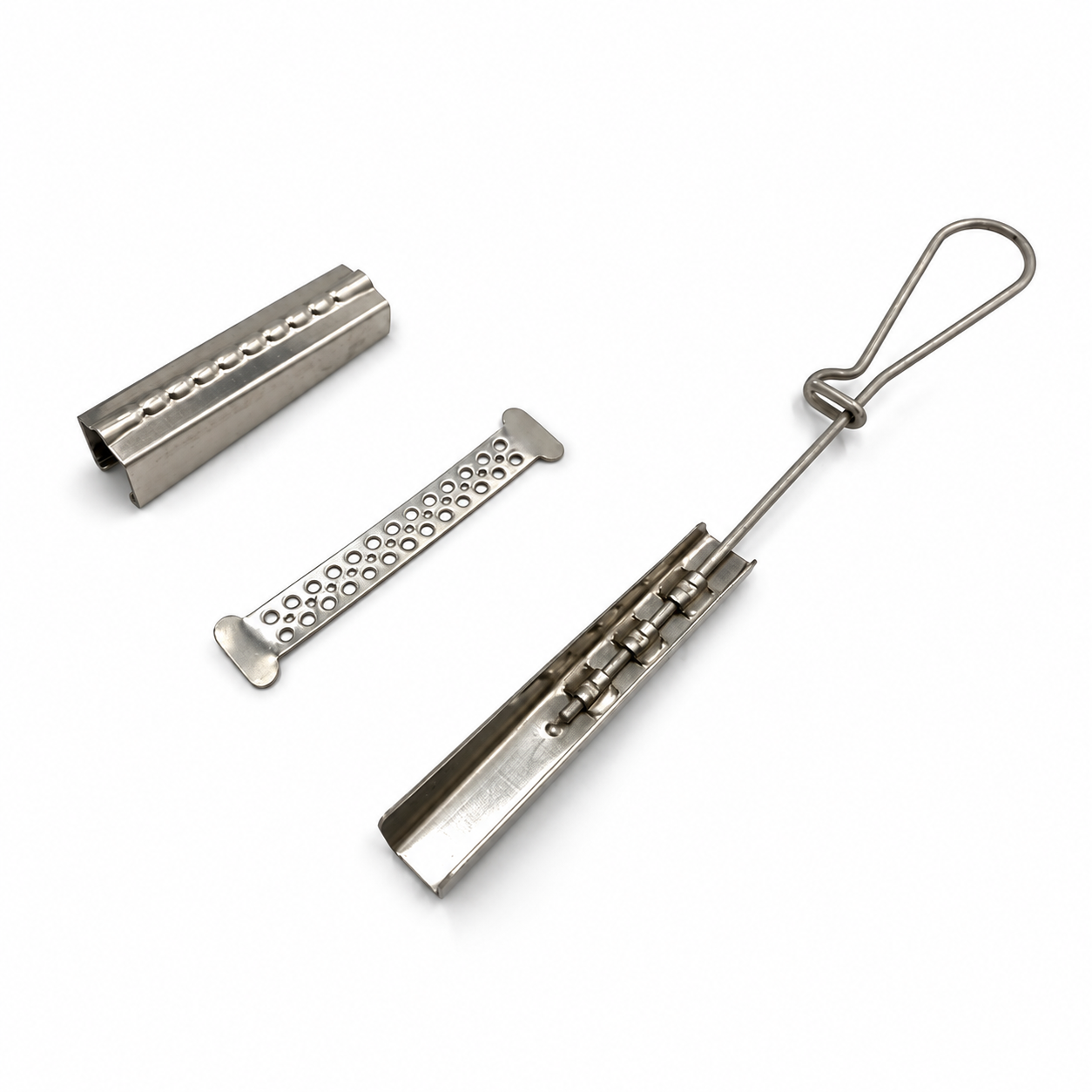
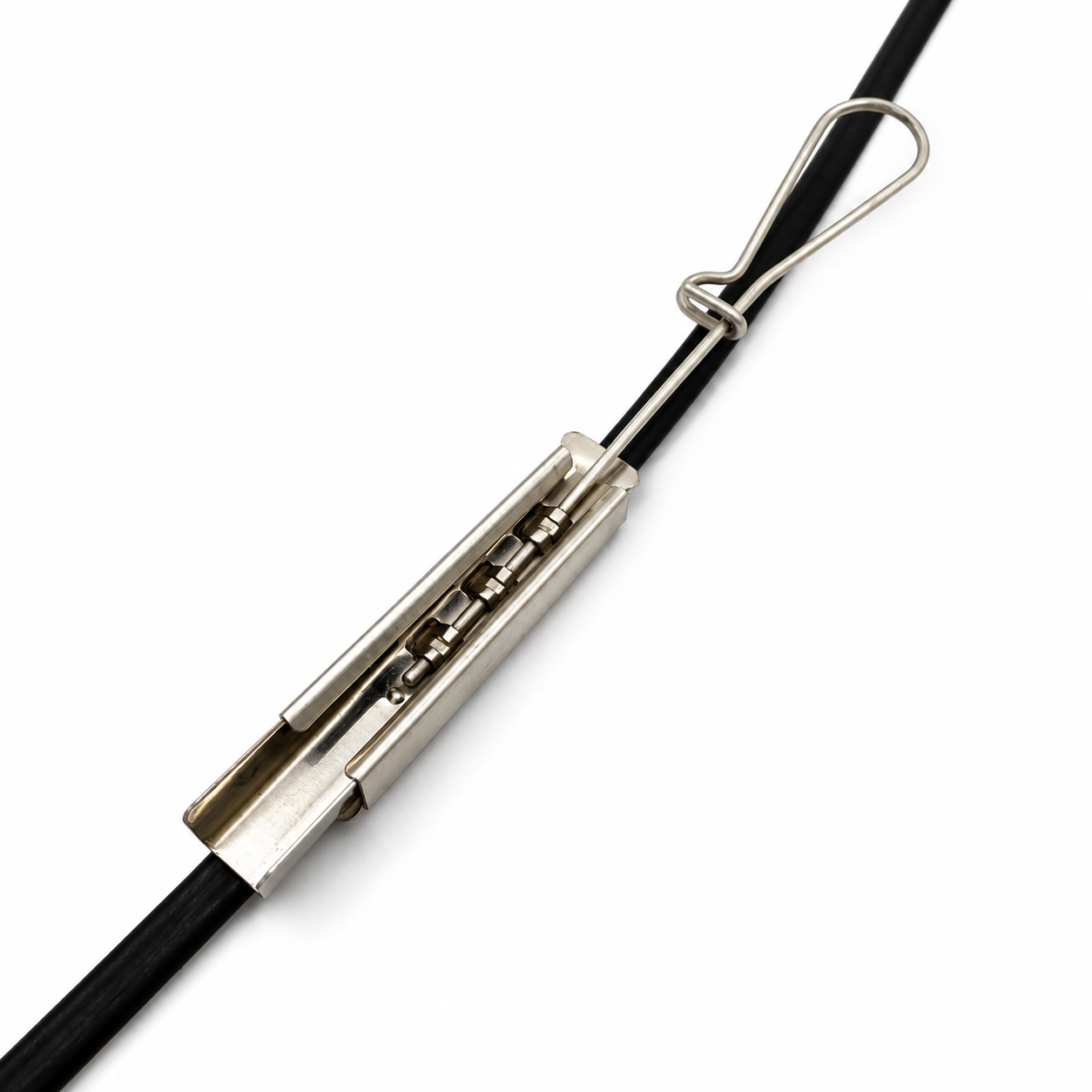
Open-Bail Stainless Steel Drop Clamp ODWAC-13S
ODWAC-13S anchors flat and round fibre optic drop cables at termination points on outdoor FTTH routes.

Features
- Hand-fitted assembly requires no additional tools
- Stainless steel construction for outdoor durability
- Opening bail connects to closed hooks
- Removable design helps protect the cable jacket during use
- Suitable for flat cable and 3–6 mm round cable
- Embossed shim perforations increase friction against the cable
- Specified span range: 30–50 m; breaking load depends on the cable
- Economical design for sustained outdoor service
Application
ODWAC-13S provides dead-end retention in aerial fibre-to-the-home and fibre-to-the-building installations. Its body, bail and gripping components work together to secure the cable; the textured contact surfaces help resist slipping.
The stainless steel assembly is intended for exposed environments where corrosion resistance and dependable mechanical retention are required. Applications include access-network expansion, extensions from distribution infrastructure and last-mile broadband deployment. The gripping arrangement supports stable cable positioning under outdoor mechanical and environmental stresses.
| Product code | Round cable diameter, mm | Flat cable size (h×w), mm | Material | MBL,KN |
| ODWAC-13S | 3-6 | <4×<13 | Stainless steel | Depend on cable |
General test method
Ultimate tensile testing measures the load a component can sustain under mechanical tension. Opposing pulling forces are applied until the specimen deforms or fractures. Measurements can include elongation, yield point, tensile strength and ultimate strength.
This method is used for pole-line suspension clamps, preformed guy grips, ADSS dead-end fittings, stainless steel banding, FTTH drop clamps and strain clamps. Endurance testing may combine tensile loading with thermal and oscillating stresses; applicable conditions are selected with reference to IEC 61284 for overhead-line fittings. Such tests can support product qualification and routine production quality control. This description explains the test method; it is not a model-specific test report.