
Spiral Vibration Dampers for ADSS Cable: How They Work and When to Use Them
Aerial fiber cable can move even when the weather does not look severe. Repeated small movements near a support can contribute to fatigue and wear over time. Spiral vibration dampers for ADSS cable are designed to reduce a particular type of movement: aeolian vibration.
They are not tension clamps, storm restraints or a remedy for incorrect sag. Effective vibration control begins with the cable, span and support arrangement, followed by a damper model approved for that application.
What is aeolian vibration?
Wind flowing across a cable can shed alternating vortices and excite relatively high-frequency, low-amplitude motion. The resulting repeated bending is especially relevant near locations where cable movement is constrained.
This is different from large-amplitude galloping or general wind-induced swing. The distinction matters because a device intended for aeolian vibration should not be assumed to control every type of cable motion. A route experiencing unusual movement needs a proper assessment before additional hardware is fitted.
How a spiral vibration damper works
A common spiral damper uses a helically formed polymer rod with two functional sections. The smaller helix grips the cable; the larger helix interacts mechanically with the moving cable to dissipate vibration energy. The damping portion is not simply a tightly wrapped protective sleeve.
PLP describes this gripping-and-damping arrangement in its spiral vibration damper technical information. That document describes the manufacturer’s products; its dimensions or application rules should not be transferred to a different model.
The practical aim is to reduce harmful vibration response, not to make the cable completely motionless. Material, helix geometry, cable diameter and operating conditions influence performance. Calling every spiral damper a soft rubber whip can therefore be misleading.
Does every aerial fiber span need a damper?
No universal answer applies to every cable or span. Review the cable manufacturer’s vibration-control guidance and the project design. Relevant factors include cable construction, diameter, operating tension, span length, terrain, wind exposure and the support system.
A short residential drop should not automatically receive the same damping arrangement as an exposed ADSS route. Likewise, a damper designed for round ADSS cable is not automatically suitable for a flat FTTH drop cable. Obtain explicit compatibility information rather than judging fit by appearance alone.
For a route with persistent wear or repeated faults, inspect the existing clamps, support alignment and sag as well. Adding dampers will not repair a damaged jacket or correct an underrated anchor assembly.
Spiral dampers and Stockbridge dampers
A spiral damper uses a helical polymer element to interact with the cable. A Stockbridge-type damper typically uses masses connected by a flexible messenger and an attachment clamp. Their selection methods and installation requirements differ.
Neither type is automatically superior for every fiber cable. Suitability depends on the cable, loading, vibration behavior and approved product design. Some projects use specific damping systems supplied or approved with the cable. Do not replace one type with another based only on weight, cost or a visual resemblance.
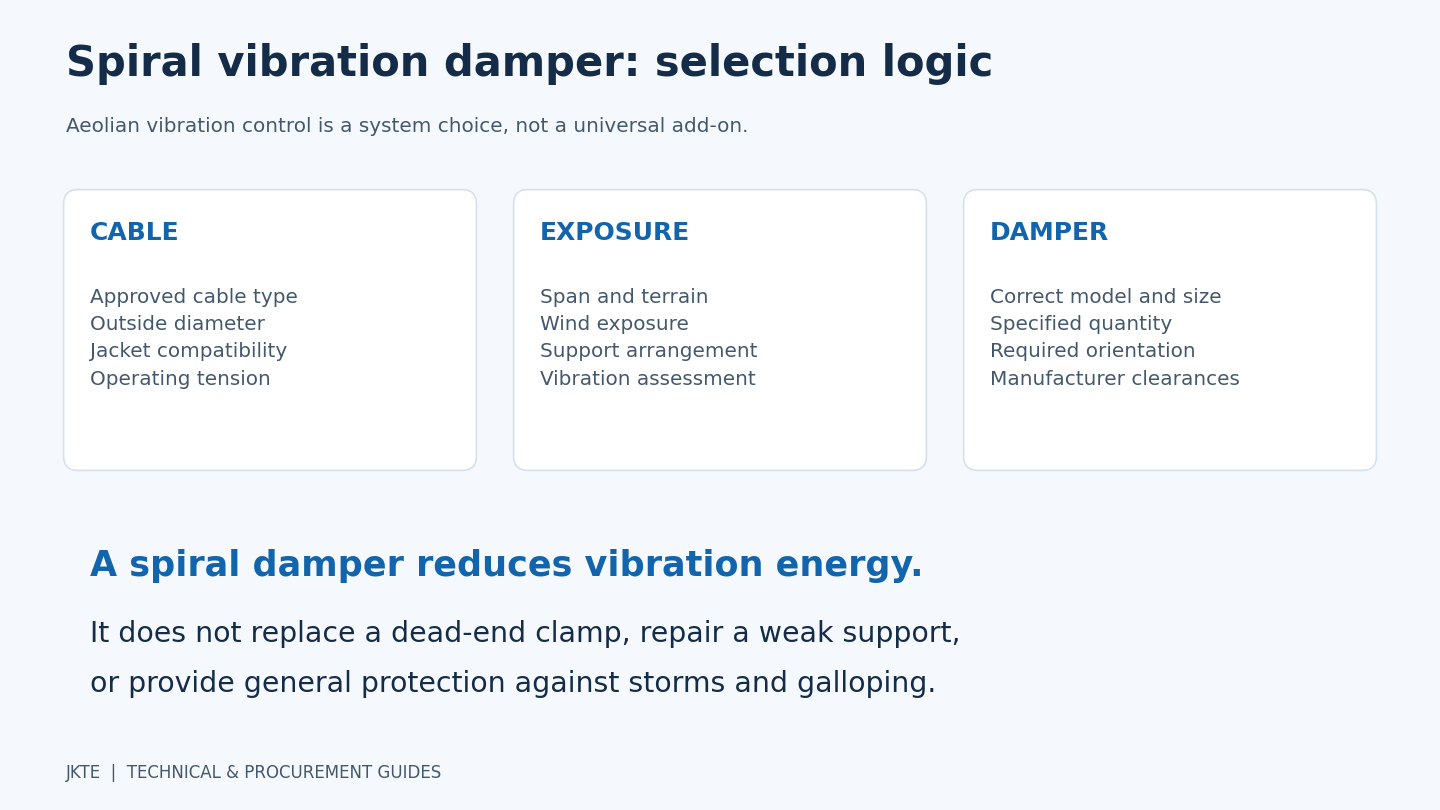
Five checks before ordering
- Cable compatibility: confirm cable type, outside diameter, jacket and any restrictions on contact materials.
- Mechanical conditions: provide the span layout and approved operating tensions.
- Exposure: describe terrain, wind exposure and relevant weather conditions.
- Product documentation: request the model’s application range, installation instructions and supporting performance information.
- Installation schedule: confirm quantities, orientation, clearances and any arrangement near other fittings.
The supplier should identify the proposed model and its limitations. A statement such as suitable for all aerial cables is not enough for procurement approval.
Installation position and quantity are model-specific
There is no universal rule that every damper must sit 0.5–1.5 m from a clamp, or that every span above 30 m needs two units at each end. Those figures should not be treated as general installation instructions.
Some designs, including the PLP FIBERLIGN spiral damper for ADSS, are described as not requiring precise positioning. This does not remove model-specific requirements for compatibility, orientation or separation from other attachments. Follow the selected manufacturer’s instructions and the approved project schedule.
During installation, protect the cable from sharp tools and excessive bending. Keep the gripping and damping sections in their intended configuration. Do not tape the entire damper tightly to the cable or modify its helix to fit an out-of-range diameter. Such changes can interfere with its operating mechanism.
Common mistakes to avoid
- Choosing by cable diameter alone: diameter is necessary, but it is not the whole application assessment.
- Confusing damping with anchoring: the damper does not carry the span in place of a dead-end fitting.
- Using a flat-drop application without approval: a round-cable device may not grip or function correctly.
- Copying another project’s quantity: different spans, tensions and exposure can require a different arrangement.
- Expecting storm protection: aeolian vibration control does not establish resistance to every extreme-weather load.
Inspection and replacement
Include dampers in the network’s inspection plan. Look for cracking, missing sections, migration, abnormal contact with adjacent fittings and visible cable-jacket wear. Compare the installed position and quantity with the approved schedule.
If damage or repeated movement is found, investigate the cause before simply replacing the component. Reuse and replacement criteria should come from the manufacturer and network owner. Laboratory weathering tests do not, on their own, justify a blanket promise of eight or ten years of field life.
Frequently asked questions
Will a damper reduce every optical fault?
No. Optical faults can result from connectors, splices, bending, contamination or damaged cable, among other causes. A damper addresses a defined mechanical vibration problem.
Can I fit an ADSS damper to OPGW?
Only where that specific product is approved for the OPGW application. The construction, installation requirements and electrical context differ.
Should the whole spiral sit tightly against the cable?
Not for designs that use distinct gripping and damping sections. Follow the product drawing; the damping section may require space to interact with the cable.
Discuss the complete aerial hardware arrangement
When contacting JKTE, include the cable type and diameter, span information, operating tension and existing support hardware. Request the applicable model documentation before purchase. You can review our fiber optic hardware range, compare ADSS suspension fittings or send your project requirements.
Related reading: ADSS cable sag, tension and fitting selection.