
Choosing ADSS tension and suspension clamps starts with the cable and the job each fitting must perform. A clamp that fits the cable diameter is not necessarily suitable for the load, jacket material or installation position.
This guide is for buyers, distributors and installation teams preparing an aerial fiber project. It explains what to compare and what information to send with an enquiry.
Tension clamp vs suspension clamp: what changes?
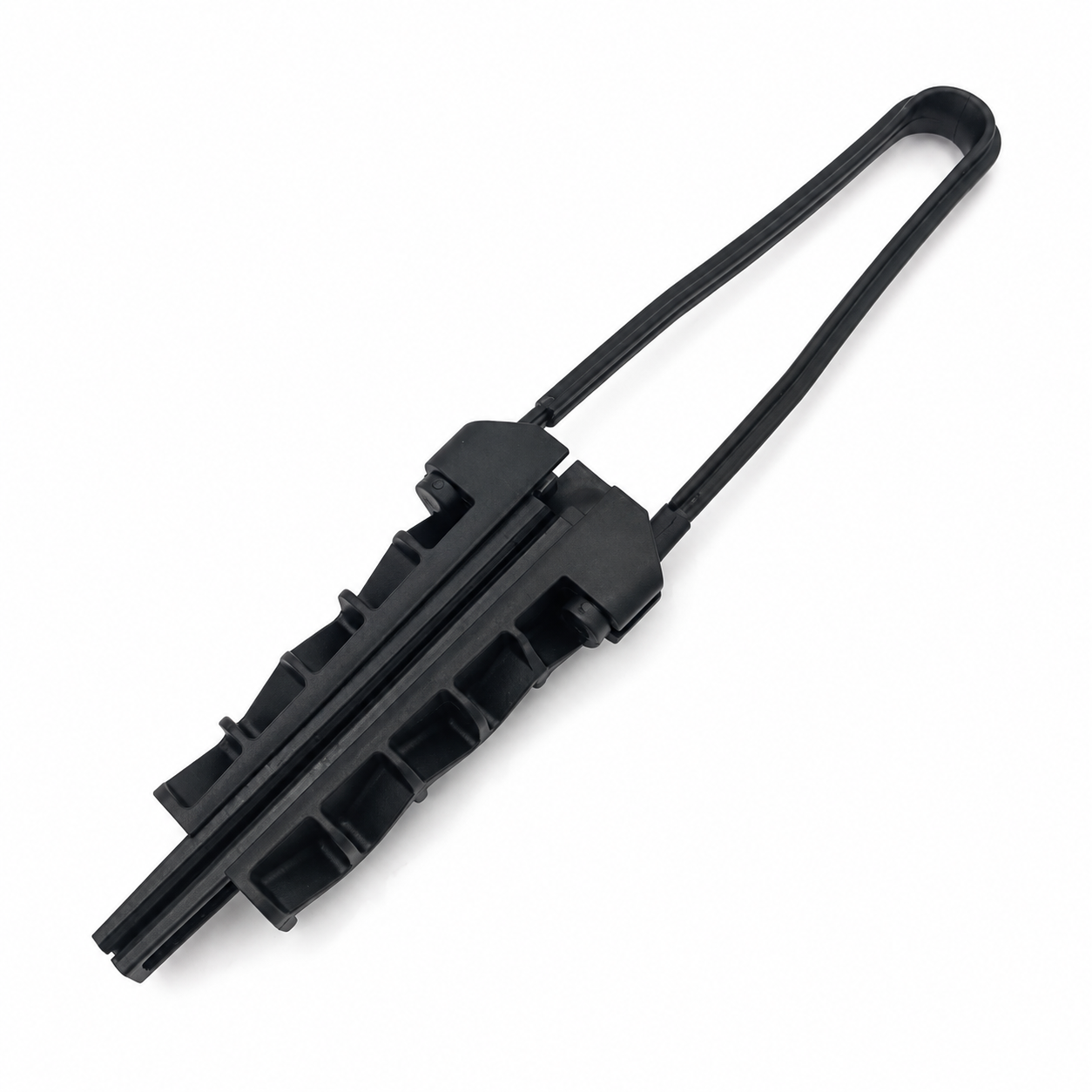
A tension clamp, also called an anchor or dead-end clamp, transfers the specified longitudinal cable load to a supporting structure. A suspension clamp supports the cable along the route. Depending on its design, it must also accommodate transverse forces, line-angle loads and specified longitudinal imbalance.
| Selection question | Tension / anchor clamp | Suspension clamp |
|---|---|---|
| Main purpose | Anchor the cable at a designed tension point. | Support the cable at an intermediate structure. |
| Typical position | Route terminations and engineered section or angle points. | Tangent supports and permitted line-angle positions. |
| Key checks | Holding performance, jacket compatibility and attachment load. | Support load, slip performance, permitted angle and cable protection. |
| Common mistake | Choosing by breaking load alone. | Using a support as a dead-end anchor. |
1. Start with the ADSS cable datasheet
Record the outside diameter, its tolerance, cable weight, jacket material and the cable manufacturer’s tension and bend-radius limits. Two cables with the same nominal diameter can have different constructions and different fitting requirements.
ADSS means all-dielectric self-supporting. Do not substitute a clamp intended for a metallic messenger or a bare conductor merely because its dimensions look suitable. For a track-resistant jacket, request explicit confirmation that the selected fitting is compatible.
2. Identify each support position
Mark terminations, intermediate supports, direction changes, changes in elevation and section boundaries on the route drawing. The hardware schedule should reflect those positions. A single clamp model is rarely a useful starting assumption for the entire route.
At an angle structure, the cable changes direction and the support loading changes with it. Check the permitted angle of the complete assembly. If the arrangement exceeds that limit, ask the designer to specify an alternative, which may include a double dead-end arrangement.
3. Check loads, not just span length
Span is an important input, but it is not a complete specification. Wind, ice where applicable, cable weight, sag and route geometry influence the loads at each fitting. A longer span in a sheltered route and a shorter span in an exposed route cannot be compared by distance alone.
Keep the terms in a quotation clear. Minimum breaking load, working load, holding strength and slip strength describe different properties. Ask which rating is being quoted, under which test conditions, and whether it applies to the proposed cable-and-clamp combination. Do not apply an assumed conversion factor between them.
4. Match the gripping design to the cable
JKTE’s ADSS anchor clamp range includes wedge-type designs. Their cable range and grip arrangement must be checked model by model. For suspension positions, compare the ADSS suspension fittings against the required support duty.
Preformed assemblies use helically shaped components around the cable; some include protective rods and additional connection hardware. The specified diameter range and assembly sequence matter. Neither a wedge design nor a preformed design is automatically suitable for every ADSS installation.
For a closer comparison of gripping arrangements, see preformed vs bolted ADSS clamps for medium and long spans.
5. Review the bracket and installation method
Check the clamp’s bail, eye or connection interface against the supporting bracket. Confirm the bracket rating, fastening method, clearances and load direction. Browse pole mounting brackets only after those requirements are clear.
Use the model-specific installation instructions. Where bolts are involved, follow the prescribed torque. Where rods are involved, follow the specified assembly arrangement. A service suspension fitting should not be treated as a stringing device unless the manufacturer explicitly permits that use.
A practical enquiry checklist
- Cable manufacturer, datasheet, outside diameter and jacket type.
- Span schedule, line angles and support positions.
- Design loads and the applicable project requirements.
- Required anchor or suspension function at each position.
- Pole or tower connection drawing and mounting hardware.
- Quantities, destination and any required inspection documents.
Frequently asked questions
Is cable diameter enough to choose a clamp?
No. It narrows the range, but jacket compatibility, mechanical loads and the installation arrangement still need to be checked.
Can a suspension clamp replace a tension clamp?
Not without an explicitly approved design. A fitting intended for intermediate support should not be assumed to provide the required anchoring performance.
Should I choose the clamp with the highest breaking load?
Only if the complete assembly is appropriate for the cable and project. A higher isolated load figure does not demonstrate compatible grip, correct installation or suitable cable protection.
Prepare your ADSS clamp enquiry
Send JKTE the cable datasheet, installation position, required load and quantity. These details allow a more useful model comparison than a request based on cable diameter alone.
Technical reference: AFL ADSS Suspension Unit documentation illustrates why jacket restrictions, line-angle limits and installation conditions must be checked for each model. Its product ratings are not JKTE specifications.