
How to Choose a Fiber Optic Accessories Manufacturer in China
Choosing a fiber optic accessories manufacturer starts with a practical question: can the supplier deliver the same approved product, with the same documented performance, throughout your project?
A competitive quotation matters, but a clamp that does not fit the cable can cost far more in rework than it saves at purchase. For distributors, telecom contractors and project buyers sourcing from China, the most useful comparison is between complete offers: product specifications, supporting evidence, delivery commitments and after-sales responsibilities.
This guide explains what to check before ordering FTTH drop cable clamps, ADSS fittings, brackets and related aerial fiber hardware.
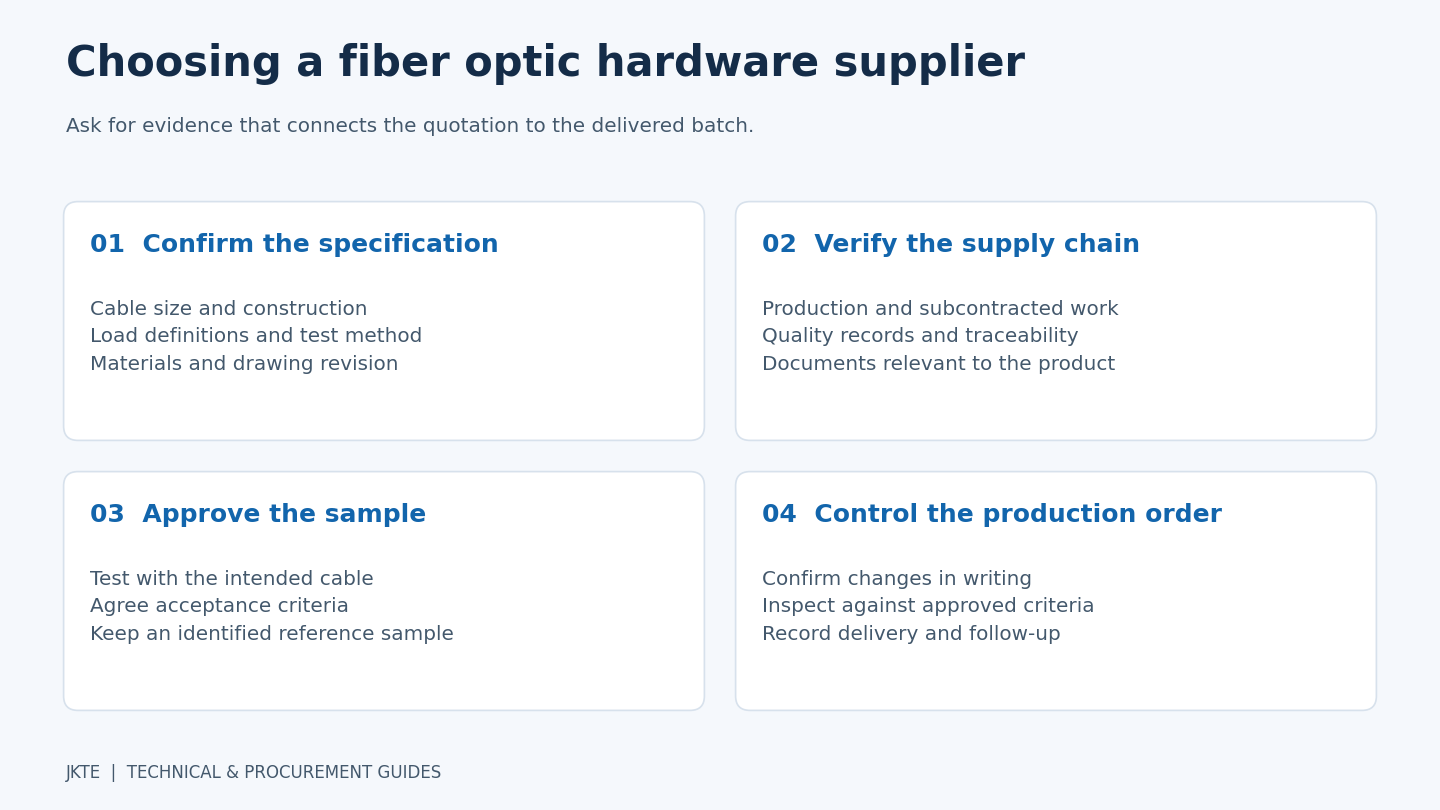
Start with a clear product specification
Send every shortlisted supplier the same information. A photograph or model number alone may not identify the correct component: similar-looking clamps can have different cable ranges, wedge profiles and load ratings.
- Cable: construction, outside diameter or flat dimensions, jacket material and the cable manufacturer’s limits.
- Application: dead-end anchoring, intermediate suspension, wall routing or down-lead support.
- Site: span lengths, exposure, temperature range and any project-specific corrosion requirements.
- Purchase: quantities by model, packaging, destination, delivery schedule and inspection requirements.
For example, an ADSS anchor clamp and an intermediate suspension clamp have different duties. Treating both as a generic cable clamp makes quotations harder to compare and increases the chance of ordering the wrong fitting.
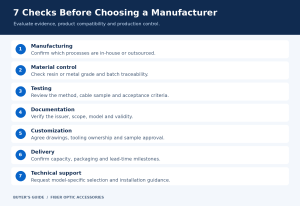
Seven checks before you approve a supplier
1. Understand who makes each component
Ask which operations the supplier performs in-house and which are subcontracted. Toolmaking, molding, metal forming, coating and assembly do not all have to take place under one roof. What matters is whether the supplier controls the specification, checks incoming work and can trace a finished batch.
A trading company is not automatically unreliable, and a factory is not automatically a good supplier. Confirm the business model, identify the responsible manufacturer and assess the evidence rather than the label.
2. Examine production capability
A live factory walkthrough can help connect the company’s claims to its actual operations. Ask to see the processes relevant to your order, the material identification system and a current production traveler or inspection record with confidential customer details removed. A polished workshop video is useful context, but it is not proof that your particular product is made there.
3. Specify materials rather than marketing terms
Descriptions such as premium plastic or rustproof metal are too vague for a purchase specification. Request the polymer designation, outdoor stabilization requirements, metal grade and coating details where relevant. Material choice should reflect the application and the evidence available. Neither black color nor the word virgin proves outdoor durability.
4. Review the test method and acceptance criteria
A load figure is incomplete unless its meaning is clear. Ask whether it represents an allowable working load, a minimum breaking load or a result obtained in a particular test. Confirm the cable used, loading rate, duration and failure criterion. A clamp body that survives a test is not necessarily acceptable if the cable slips or the jacket is damaged.
Weathering and corrosion reports also need context: the sample, exposure conditions, assessment method and pass criteria should be identifiable. A laboratory exposure period cannot by itself establish a fixed outdoor service life.
5. Check documents for the actual product
Match the company name, manufacturing site, product identification, report number, issue date and scope. An ISO 9001 certificate concerns a quality management system; it does not certify the performance of every model. Ask the issuer or testing body to confirm a document when necessary.
Do not treat CE marking or a RoHS statement as a universal requirement for all mechanical fiber fittings. The applicable rules depend on the product and destination. The European Commission’s CE marking guidance explains that CE marking applies only to products covered by the relevant legislation. Agree the compliance documents required by your project before placing the order.
6. Assess customization and change control
For an OEM or ODM order, establish who owns the drawing and tooling, how revisions are approved, which dimensions are critical and how sample approval works. Confirm tooling charges, the sampling schedule and the tests required after a material or geometry change. An undocumented substitution can invalidate an otherwise useful sample approval.
7. Agree delivery and after-sales responsibilities
Ask for a realistic production schedule that identifies material purchasing, manufacture, inspection and dispatch. Specify carton quantities, labeling and protection against transport damage. Agree how nonconforming goods will be reported, assessed and resolved, with a named commercial contact and access to technical support.
A practical remote verification process
- Screen the quotation: compare the same dimensions, materials, test requirements and delivery terms.
- Review evidence: check company details, relevant certificates and sample inspection records.
- Verify capability: hold a live technical discussion and, where useful, arrange an independent factory audit.
- Approve samples: test the actual cable-and-fitting combination against agreed criteria. Retain an identified reference sample.
- Run a controlled first order: inspect production goods and packaging, then review installation feedback before increasing order volume.
This process reduces uncertainty; it does not eliminate every risk. A small first order is useful only if the products and records represent the intended production process.
What should a sample evaluation include?
Check dimensions, finish, sharp edges, assembly and fit with your intended cable and support hardware. Agree functional tests before testing starts. Record sample identifiers, photographs, results and any changes requested. For load-bearing fittings, use appropriate controlled testing rather than an informal hand pull.
When reviewing installation guidance, look for clear cable limits, attachment instructions and acceptance checks. Our FTTH drop cable clamp installation guide explains the questions a field team should resolve before installation.
Warning signs worth investigating
An unexplained price difference, an unidentified test sample or an unwillingness to define a load rating deserves follow-up. None is proof of misconduct on its own. Ask the supplier to explain the difference in writing. Avoid accepting broad promises such as suitable for every climate, zero failures or guaranteed approval in every market.
Frequently asked questions
Is buying directly from a factory always cheaper?
Not necessarily. Compare the total delivered cost, order quantity, inspection effort and service offered. Direct sourcing may simplify technical communication, while a capable distributor can add useful consolidation or local support.
Can I approve a clamp from its catalog load rating?
No. You also need cable compatibility, a defined test method and confirmation that the complete assembly meets the project requirements.
Which documents should accompany a bulk order?
Agree the list in the purchase order. It commonly includes the commercial invoice, packing list, product identification, approved specification and agreed inspection records. Regulatory and customs documents depend on the destination and product.
Prepare your inquiry for JKTE
Send JKTE your cable dimensions, intended application, quantities and delivery destination. If you have a project specification or drawing, include it so that model selection and quotation can be based on the same requirements. Explore our fiber optic hardware range or request a quotation.